
Which Online Courses Are Worth It for a UK Career Change?
There is no single best online course for a career change in the UK. The right choice depends on the sector you want to enter.
For consistent employer recognition and strong labour market demand, career changers should consider:
• CIPD Foundation Certificate in People Practice Level 3 (for HR)
• AAT Level 2 Certificate in Accounting
• PRINCE2 Foundation in Project Management
• CompTIA A+ in IT Support
• Google Cybersecurity Professional Certificate
These are among the strongest starting points.
The table below covers the above five plus five more career paths in detail.
| Career Path | Course | Best for | Provider | Time and cost | Recognition |
|---|---|---|---|---|---|
| IT Support | CompTIA A+ | Fast, well-recognised route into help desk or technical support | Udemy (prep and exam voucher) | ~1 to 6 months, depending on prior IT experience, training prices vary on site | Industry standard |
| Cyber Security | Google Cybersecurity Professional Certificate | No experience route into SOC analyst or IT security roles | Coursera | ~6 months at 7 hours/wk, ~£148.50 to £258 (less if studying more hours/wk). | Google hiring consortium and leads to CompTIA Security+ |
| Health and Social Care | NCFE CACHE Level 3 Certificate in Preparing to Work in Adult Social Care | No care background needed, provides groundwork before applying for a care role | Open Study College | ~12 months, currently from £599 | NCFE CACHE, Ofqual regulated |
| HR and People Practice | CIPD Foundation Certificate in People Practice Level 3 | Instantly recognised route into HR or L&D | Open Study College | 6 months, currently from £1,949.00 | CIPD accredited |
| Accounting | AAT Level 2 Certificate in Accounting | Recognised route into accounting or finance from scratch | Open Study College | up to 12 months, currently from £719 | AAT accredited |
| Project Management | PRINCE2 Foundation | Government, public sector and structured delivery roles | Udemy | 6+ weeks, training prices vary on site | AXELOS /PeopleCert accredited |
| Data and AI | Google Data Analytics Professional Certificate | Complete beginners wanting a structured route into data analytics | Coursera | ~6 months at 10 hours/wk, ~£148.50 to £258 (less if studying more hours/wk) | Google hiring consortium |
| Digital Marketing | Google Digital Marketing and E-commerce Certificate | Broad, practical introduction with no prior experience needed | Coursera | ~6 months at 10 hours/wk, ~£148.50 to £258 (less if studying more hours/wk) | Google hiring consortium |
| UX and Product Design | Google UX Design Professional Certificate | Portfolio-first route into tech for creative problem-solvers | Coursera | ~6 months at 10 hours/wk, ~£148.50 to £258 (less if studying more hours/wk) | Google hiring consortium |
| Software Development | Meta Back-End Developer Professional Certificate | Structured, affordable route into back-end development | Coursera | ~8 months at 6 hours/wk, ~£148.50 to £344 (less if studying more hours/wk) | Meta hiring consortium |
There are hundreds of online courses promising to change your career. Most of them won’t. A handful will. The difference usually comes down to two things. First, whether employers recognise the qualification. Second, whether it is in a part of the job market that’s hiring right now.
I’ve spent 20 years advising people through career changes. Below I share the career-change courses I think are worth considering in the UK in 2026-27. I also discuss the types of courses I’d avoid.
Table of Contents
How to Choose Which Online Courses Are Worth It for a UK Career Change
Picking the right online course for a career change takes more thought than most people give it. You want something that moves your career path forward, not just a certificate to add to LinkedIn.
1. Choose an Online Course Based on Employer Recognition Rather Than Completion Certificates
Finishing a course proves initiative. It doesn’t automatically prove you have the right skills and knowledge in the eyes of an employer. A completion certificate from an unknown provider carries far less weight than an accredited qualification from a recognised body.
CIPD, AAT and CompTIA all carry real weight with UK recruiters, because employers already recognise what those qualifications signify.
Google’s professional certificates work slightly differently. They are not accredited qualifications in the traditional sense. However, Google’s hiring consortium of employer partners actively recruits graduates, which gives them practical value even without formal accreditation.
Before you enrol, ask a simple question. If you put a qualification on your CV, would the hiring manager know what it means without googling it?
2. Choose an Online Course Based on Labour Market Demand Rather Than Course Popularity
A course with huge enrolment numbers isn’t automatically the right choice for you. What matters more is whether the sector you’re moving into is growing. The sector should be hiring at a level you would benefit from as career changer with no experience.
Health and social care, data, HR, project management, IT support and cyber security all have consistent UK demand. These sectors are driven by shortages that show no sign of closing.
Digital marketing and UX design are more competitive but still growing. Match your course to where the jobs are, not to whichever course has the flashiest advert.
3. Choose a Online Course which Supports Your Desired Career Change
Start with the job and work backwards from the role.
Ask yourself:
- What job do I want in twelve months?
- Which type of work interests me most?
- Do I enjoy working with people, technology, data or finances?
- Do I want a structured profession with recognised qualifications?
- How much time can I commit to completing a qualification?
- How quickly do I want to move into a new role?
- Do I want office-based, remote or front-line work?
- What salary range am I aiming for in the next three to five years?
- What does that employer need to see on my CV?
Once you’ve identified the type of work you want to do, choosing the right course becomes much easier.

How I Evaluated and Chose the Courses Below
I judged each course on four things:
- Employer recognition
- Realistic time and cost
- The strength of the career path it opens
- Whether it fits someone starting from scratch.
I’ve linked to the actual provider pages so you can check current pricing yourself, since course fees do shift.
Can I get Free Funding for Online Courses?
Some qualifications in this guide may be available for free through government-funded routes, depending on your circumstances. Adults can get their first full Level 2 qualification funded. Separately, some adults without a Level 3 qualification can access the Free Courses for Jobs scheme for eligible courses.
The catch is who gets these for free. If you’re 19 to 23, funding is generally automatic regardless of income. For anyone 24 or over, free access usally depends on being unemployed or on a low wage.
Funding is also tied to specific approved colleges and training providers rather than to a qualification title in general. Check the National Careers Service course finder for your circumstances and local area before paying for a course.
A paid, self-paced option is worth it mainly for the flexibility and the immediate availability. Also, if you don’t qualify or can’t wait for a funded place.
The Best Career Change Courses in the UK, by Career Path
1. IT Support: CompTIA A+
Best for: people who want a fast, well-recognised route into help desk or technical support roles.
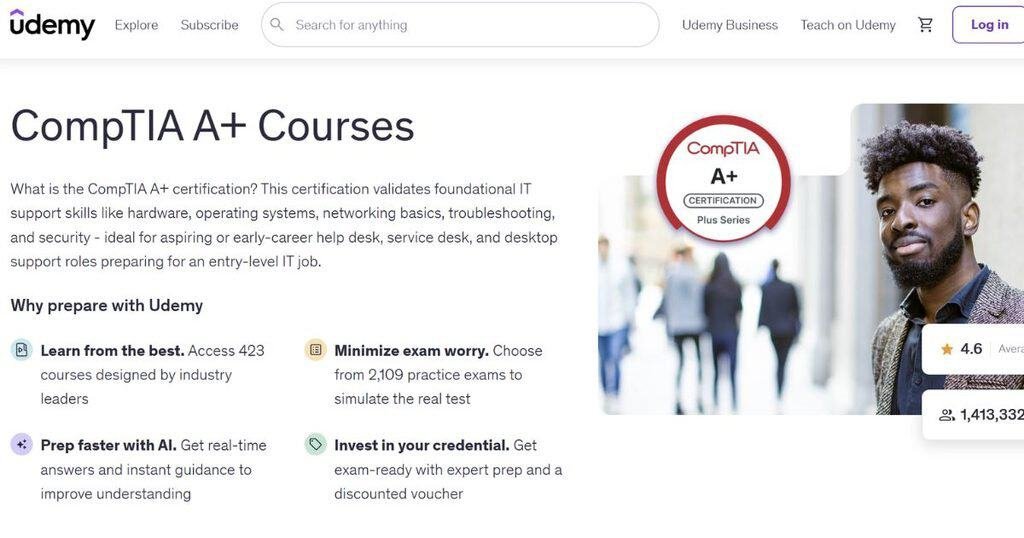
CompTIA A+ is the internationally recognised entry-level standard for IT support. Many enterprises list it as a requirement for entry-level tech roles.
It covers hardware, operating systems, networking basics and troubleshooting across two exams. The training and exam prep for both Core exams takes most people 1 to 6 months to complete. How long it takes usually depends on prior IT experience.
The certification itself is separate from any training course, since CompTIA sets and runs the exams.
Udemy’s CompTIA A+ hub gives you a wide range of instructor-led prep courses at different price points. So it’s worth reading reviews before picking one.
The same page also sells the official CompTIA A+ exam voucher directly. It includes an option with a free retake if you don’t pass the first time. This means you can secure the training and exam in one place.
2. Cyber Security: Google Cybersecurity Professional Certificate
Best for: Career changers wanting a structured, no-experience-needed route into SOC analyst, IT security analyst or cyber defence roles.
The Google Cybersecurity Professional Certificate is an eight-course programme. It covers network security, threat detection, SIEM tools, Linux, Python and SQL. Google designed this certificate for people with no security background.
What makes this one worth your time and money is the built-in bridge to CompTIA Security+. Graduates can access CompTIA Security+ training and the exam at a discounted price.
A Quick Note on Coursera Subscriptions
You can access the Google Cybersecurity Professional Certificate on Coursera with a monthly subscription. Most learners complete it in about 6 months by studying 7 hours a week.
Alternatively, you can access it through the Coursera Plus Monthly or Annual Subscription. This may work out cheaper, especially when Coursera is running offers.
The Coursera Plus Monthly or Annual Subscription gives you access to several of the other Google and Meta Professional Certificates. Some of these professional certificates are mentioned in this guide below. If you want to achieve more than one certificate, that is where you will find the real savings.
3. Health and Social Care: NCFE CACHE Level 3 Certificate in Preparing to Work in Adult Social Care
Best for: Career changers with no care background who want a no-experience-needed starting point before applying for their first care role.
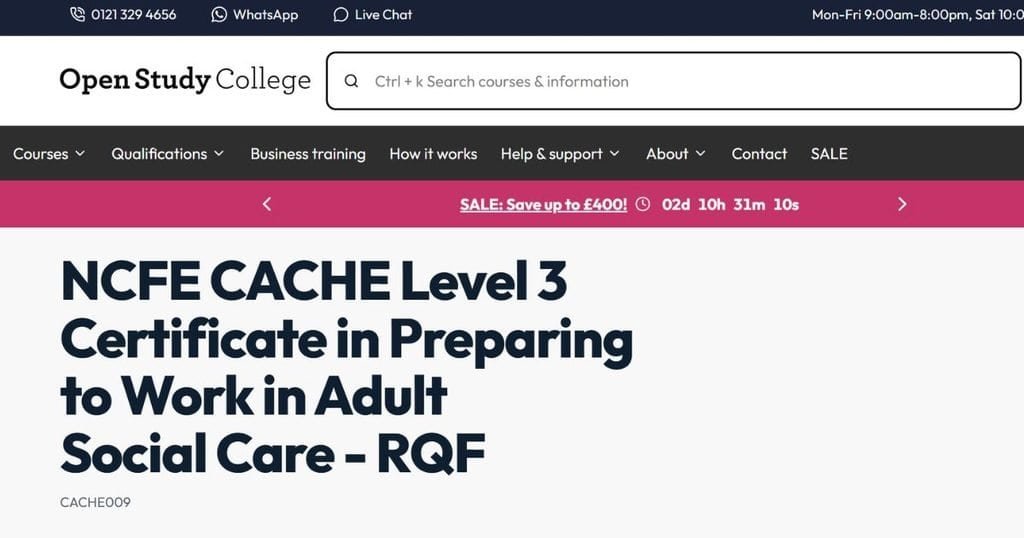
The NCFE CACHE Level 3 Certificate in Preparing to Work in Adult Social Care is the right starting point if you have no care background at all. It’s a knowledge-based qualification, so you don’t need prior experience or workplace access to enrol. This contrasts with the further qualifications in this sector, which do require you to be working or volunteering in care.
It takes around 12 months of self-paced study. It covers communication, safeguarding, person-centred approaches, health and safety and duty of care.
Once you’ve built that groundwork, here’s how the sector works in practice. Most entry-level care roles require no formal qualification to start. So your next step is simply to apply, including through the Adult Care Worker Apprenticeship.
Once you’re in post, you’ll complete the statutory Care Certificate through your employer, usually free, within your first 12 weeks. From there, you can progress into the Level 3 Diploma in Adult Care. The Level 3 qualification leads to senior care worker, coordinator and team leader roles. Many employers fund this directly once you’re employed.
4. HR and People Practice: CIPD Level 3 Foundation Certificate in People Practice
Best for: anyone wanting to move into HR or learning and development with an instantly recognised qualification.
CIPD is the professional body for HR in the UK. The CIPD Level 3 Foundation Certificate is the qualification most UK employers expect to see when recruiting for entry-level HR roles. If you’re serious about moving into HR, this is usually the first qualification I suggest.
This qualification covers recruitment, employee relations and the essentials of people practice. You need to complete four written assignments across four units.
Most learners complete it in six months. It leads to CIPD Foundation membership on completion, which is worth having on its own. It opens the door to roles such as HR Administrator or HR Assistant, typically starting in the £24,000-£33,000 range. The actual salary you receive usually depends on location and employer.
5. Accounting: AAT Level 2 Certificate in Accounting
Best for: anyone starting from scratch who wants a recognised route into accounting or finance.
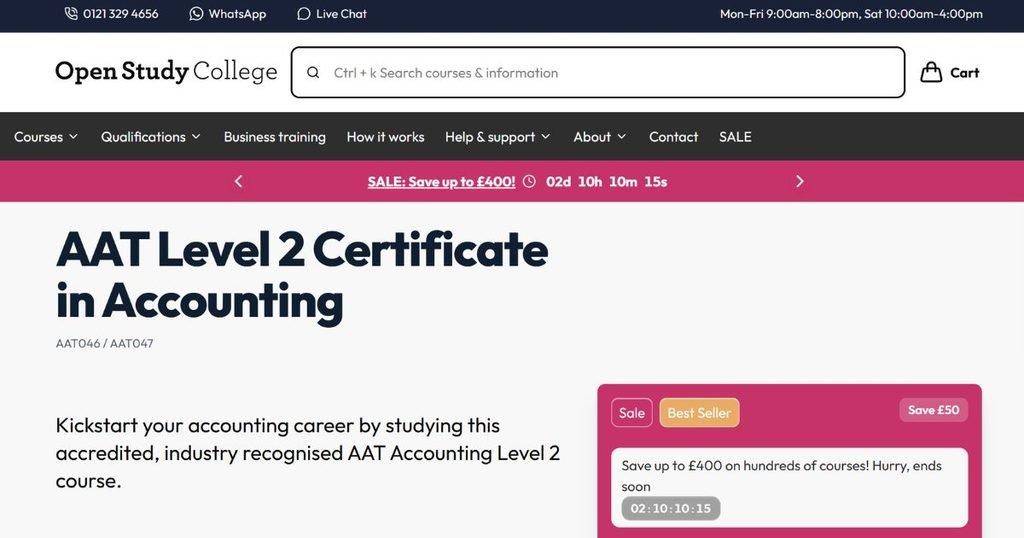
AAT has become the standard entry route into accounting in the UK for people without a degree in finance.
The AAT Level 2 Certificate in Accounting covers double-entry bookkeeping, basic costing and Sage Business Cloud software. These are all skills employers expect from day one. It usually takes up to twelve months.
It’s a first step. Most people use it as the foundation for the AAT Level 3 Diploma in Accounting and eventual MAAT status. If you would like to do both, you could save money by bundling the AAT Level 2 and 3 Accounting courses. You can save more than £300.
Even at Level 2, it opens up roles such as an accounts assistant or a finance administrator.
6. Project Management: PRINCE2 Foundation
Best for: anyone moving into UK project management, particularly government, public sector or structured corporate delivery roles.
PRINCE2 Foundation is the strongest single pick for most UK career changers moving into project management. This is especially true for government, public sector, PMO or structured corporate delivery roles. These roles make up a large share of UK project work.
Udemy offers a range of self-paced PRINCE2 prep courses from experienced instructors. These courses are always open with no scheduled start date, making it the easiest way to begin straight away.
These are training courses rather than the official exam itself. So once you’ve worked through one, you’ll book your PRINCE2 Foundation exam separately through an AXELOS-accredited provider.
Other Project Management credentials are worth knowing about, even though PRINCE2 is the better starting point for most people.
The Google Project Management Certificate is a lower-commitment alternative for someone starting from absolute zero. This is for you if you want to test the waters before paying for an accredited exam.
It’s a certificate of completion rather than a professional qualification, so it won’t carry the same weight as PRINCE2 or APM. Still, it’s an accessible, low-cost way to learn the fundamentals of Agile, Scrum and traditional project delivery before committing to an accredited exam.
APM is the UK’s chartered body for the project profession. Its Project Fundamentals Qualification is a broader, principles-based route rather than a single methodology. It provides a clear progression path through to Chartered Project Professional status. You can study through an APM-accredited training provider, or self-study and book the online exam directly with the APM.
7. Data and AI: Google Data Analytics Professional Certificate
Best for: Complete beginners wanting a structured route into data analytics.
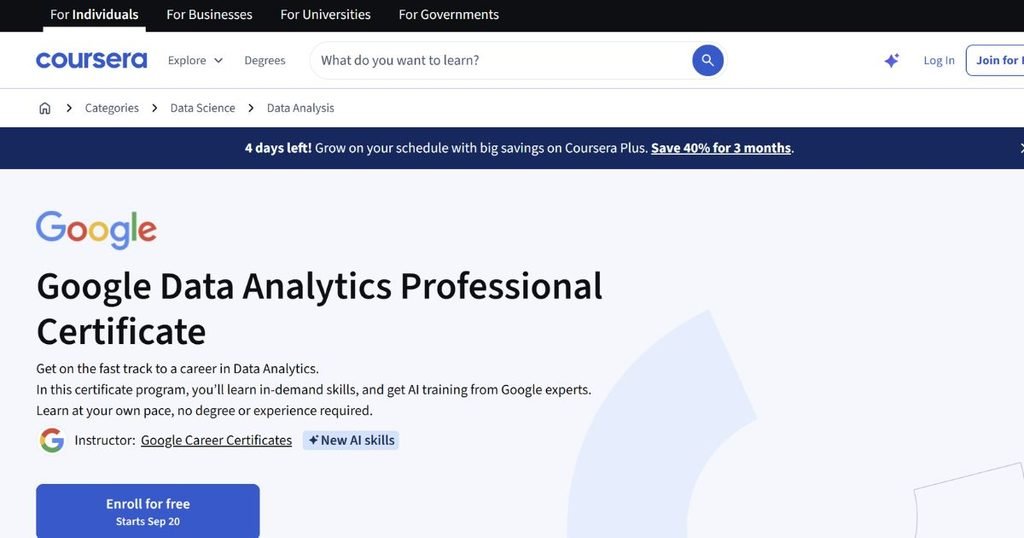
Google Data Analytics Professional Certificate is an eight-course programme. It covers spreadsheets, SQL, Tableau and R, and is built for people with zero data experience.
You can access this course on Coursera. Most learners complete it in about 6 months by studying 10 hours a week.
If you already know you want to go further into machine learning, the IBM Data Science Professional Certificate is worth comparing.
8. Digital Marketing: Google Digital Marketing and E-commerce Professional Certificate
Best for: creative, self-directed learners wanting a broad, practical introduction to digital marketing with no prior experience needed.
The Google Digital Marketing & E-commerce Professional Certificate covers SEO, social media marketing, email marketing, e-commerce and analytics. It’s part of the same Google Career Certificate family as the data analytics and cybersecurity certificates earlier in this guide.
You can access this course on Coursera. Most learners complete it in about 6 months by studying 10 hours a week.
If you’re already working in marketing with a year or so of experience, consider the CIM Level 4 Certificate in Professional and Digital Marketing. This qualification is accredited by the Chartered Institute of Marketing (CIM).
The CIM Level 4 in Digital Marketing is the qualification that UK employers specifically reference in the marketing profession. However, it isn’t suited to someone starting from complete scratch, since it typically requires prior experience or a Level 3 qualification to enrol.
9. UX and Product Design: Google UX Design Professional Certificate
Best for: creative problem-solvers who want a structured, portfolio-first route into tech.
The Google UX Design Professional Certificate takes you through the full UX process (user research, wireframing, usability testing). As a bonus, you leave with a portfolio of real projects rather than just a certificate.
You can access this course on Coursera. Most learners complete it in about 6 months by studying 10 hours a week.
The portfolio is what gets people hired in design, more than the certificate itself. Treat the coursework as the starting point for three or four strong case studies you can show in interviews.
10. Software Development: Meta Back-End Developer Professional Certificate
Best for: Career changers wanting a structured, affordable route into back-end development with no prior coding experience.
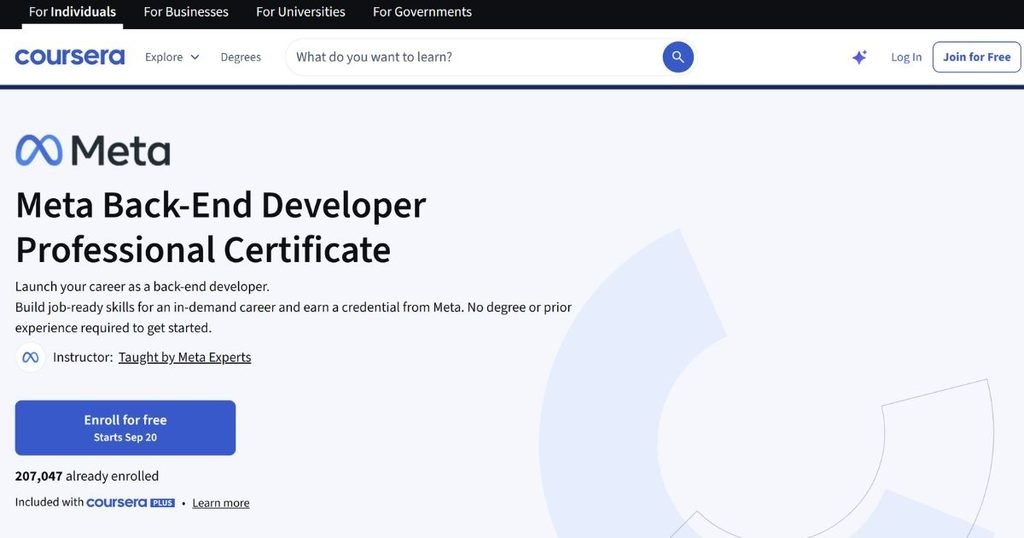
The Meta Back-End Developer Professional Certificate teaches Python, SQL, Django, APIs and database design. It requires no degree or prior coding experience.
You can access this course on Coursera. Most learners complete it in about 8 months by studying 6 hours a week.
Traditional coding bootcamps can get you there faster, often in ten to twenty-four weeks. However, they typically cost several thousand pounds.
Bootcamps also vary widely in quality across providers. So thorough research into outcomes and job placement rates matters before committing to one.
A structured Professional Certificate gives you a comparable skill set at a fraction of the cost and pace pressure. This makes the Meta Back-End Developer Professional Certificate a more sensible starting point for most career changers.
Should UK Career Changers Do an AI course?
I often get asked whether career changers should add an AI course to their training portfolio. Most standalone “AI certificate” courses online are low-quality and offer little real recognition. So I wouldn’t recommend them as your main qualification.
What is worth doing is building basic AI literacy alongside whichever course you pick from this list. Google AI Essentials, delivered on Coursera, covers practical prompting and responsible use in under ten hours.
It won’t get you hired on its own, but it’s a sensible add-on. It shows you can use the tools your future employer almost certainly expects you to know. Plus, Coursera includes this course in the subscription. Or it could likely be completed as part of the 7-day free trial.
Which Online Learning Platforms Are Worth Trusting?
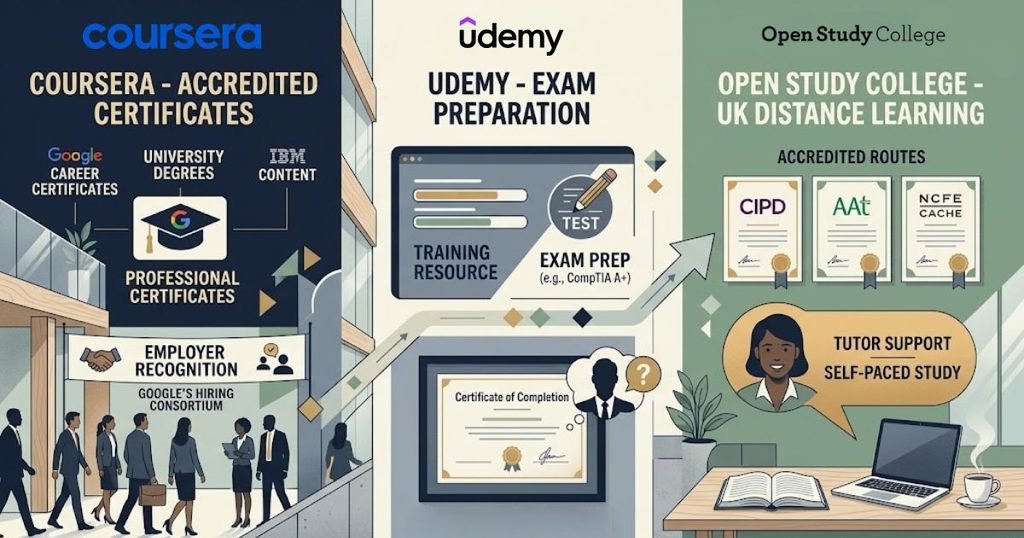
Coursera hosts most of the Google Career Certificates alongside university and IBM content. The professional certificates carry real employer recognition thanks to Google’s hiring consortium.
Udemy is a training resource rather than a source of accredited qualifications. It’s useful for exam prep, like CompTIA A+, but the certificate of completion itself carries little independent weight.
Open Study College is a UK distance-learning provider for accredited routes like CIPD, AAT and NCFE CACHE. It bundles tutor support into the course price, which suits self-paced study outside a classroom.
Online Courses I Would Avoid for a Career Change
Steer clear of any course that won’t clearly explain how employers recognise it.
If a provider can’t tell you which bodies accredit the course, that’s also a sign to walk away.
Be wary of unaccredited coaching or consulting certifications, too. Some are useful for personal development, but they rarely carry weight with recruiters. So don’t rely on one as your sole qualification for a career change.
Ignore anything that promises unrealistic salaries after a few weeks of study. Real career changes and salary progression take time. Research typical salaries in your target industry before you commit, so your expectations align with reality.
Frequently Asked Questions
Are online courses recognised by UK employers?
UK employers recognise some online courses, but not others. Accredited qualifications from bodies like CIPD, AAT, APM and CompTIA are widely recognised by name.
Google’s professional certificates aren’t formally accredited but carry practical weight through Google’s employer hiring consortium.
Generic completion certificates from unknown providers carry the least weight.
How long does it take to change careers with an online course?
Most of the courses in this guide take between six weeks and twelve months, depending on the qualification. PRINCE2 Foundation can be done in six weeks. CIPD and AAT typically take six to twelve months.
However, no one can anticipate how long the job search process will take after completing the course.
Do I need a university degree to change career in the UK?
No.
Every course in this guide is for people without a degree in the relevant field.
Also, most require no prior experience.
Which online course has the best return on investment?
The ones with the clearest route to a specific job title tend to have the strongest ROI. CIPD Level 3 for HR roles, AAT Level 2 for Accounting roles, and CompTIA A+ lead directly to named entry-level positions. The Google Cybersecurity Certificate for IT and security roles does the same.
Should I do more than one course?
Usually not at the start. Pick one accredited course that matches your target sector, complete it, and gain real-world experience before adding a second qualification. Stacking unfinished courses rarely helps your CV.